


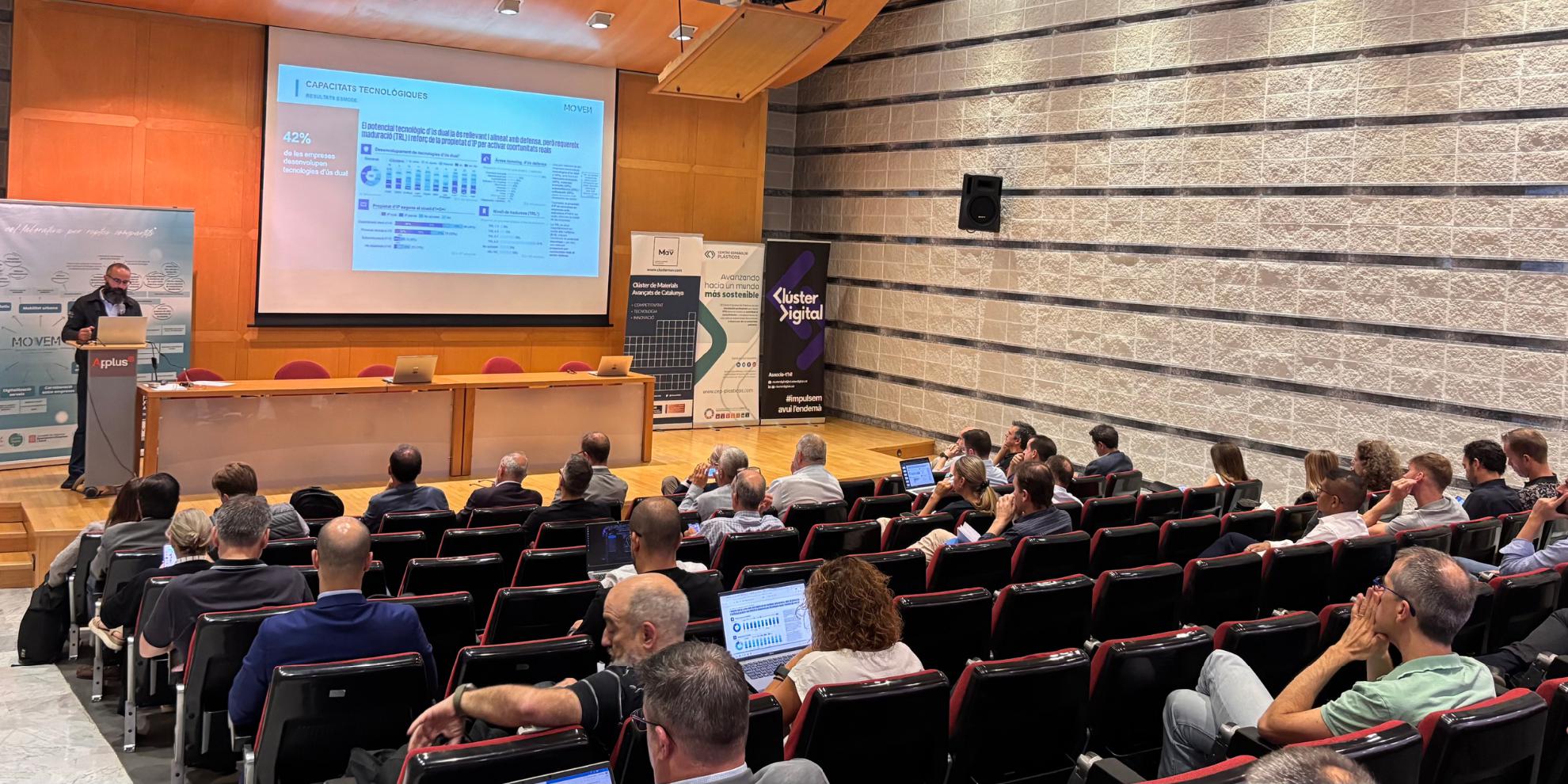
On 23 September, MOVEM – Alliance for Sustainable Mobility of Catalonia held the Dual Technologies Conference: Capability Assessment at the Applus+ Laboratories facilities in Bellaterra, a meeting focused on the opportunities that the new context of the defence sector can generate for the Catalan industrial, technological and service fabric. Clúster Digital de Catalunya, as a member of MOVEM, participated in the conference, which brought together about sixty representatives of the Catalan business ecosystem, clusters and administration.
The event began with the welcome of Genís Gil Costa, from Applus+ Laboratories, and the institutional interventions of Josep Maria Vall, president of MOVEM and the CIAC, and Tomás Megía, manager of the OPTIMA office of the Generalitat de Catalunya. The introduction of the conference was given by Ona Bombí Aymerich, Cluster Manager of the MAV Cluster.
A new context that opens up opportunities for the Catalan ecosystem
The conference served to present the results of Phase I of the ESMODE project, an initiative promoted by ACCIÓ and MOVEM with the aim of assessing the capabilities of the Catalan mobility ecosystem and adjacent sectors and identifying the potential of companies in the field of defence.
The study is based on a context of transformation in the defence sector, marked by an increase in investment and the deployment of new modernisation and capability acquisition programmes. This scenario is generating new opportunities for the industrial and technological fabric, but it also implies more demanding requirements in terms of capabilities, regulation and security.
Within this framework, MOVEM brings together an ecosystem of more than 1,600 entities and the ESMODE project has specifically analysed the capacities of a perimeter of companies that have shown interest in exploring new businesses in this area of opportunity.
170 companies analysed and a base with diversification potential
The results of the Phase I report of the project, prepared by KPMG, show a diverse business ecosystem with a significant industrial and technological base. In total, the analysis presented at the conference includes 170 companies. The evaluation has been structured around six dimensions: profile and positioning, fit and interest, technological capabilities, industrial capabilities, regulation and security, and ecosystem and financing.
Among the main conclusions are:
Nearly 80% of the companies analysed show a high or very high interest in the defence sector, although their current relationship with this area is still limited.
With regard to technology, 42% develop dual-use technologies, with applications related to areas such as advanced manufacturing, software and materials. The report also points out the need to continue advancing in technological maturity and consolidation of intellectual property in order to turn this potential into market opportunities.
In the industrial sector, 52% have a high potential to operate in short series, a particularly relevant factor in a sector characterised by more specific projects and production volumes different from those of conventional automotive.
The study also highlights a good basis in terms of regulation: 74% of companies have ISO 9001 certification and 67% have experience in regulated sectors. At the same time, specific certifications, licences and knowledge of the defence market appear as the main areas of development.
Finally, 83% show a willingness to invest specific resources to make progress in this area, which points to a growing interest in exploring new ways of diversification and positioning.
The results of ESMODE offer a first snapshot of the industrial and technological capacities of the ecosystem and allow the identification of strengths and areas of development to facilitate a progressive evolution towards activities and value chains linked to defence.
The Phase I report includes the profile of the companies analysed, their technological and industrial capacities, the degree of preparedness in regulation and security, as well as their experience in collaborative ecosystems and financing.
📄 Check out the full report on the results of Phase I of the ESMODE project here.
The conference also served to present the four areas of work of the MOVEM Defence and Dual Technologies Commission, designed to respond to the different needs of companies interested in advancing in this ecosystem: certifications and approvals, Product, Process and R+D.
The presentation of the results of the study was given by Josep Nadal, Cluster Manager of the CIAC, while Jaume Canals, Cluster Manager of the Light Mobility Cluster, presented the new areas of work of MOVEM in dual technologies.
Phase II will delve into the capabilities of each company
After the global x-ray obtained in this first phase, the project foresees a second phase of individualized analysis. This will allow the participating companies to know their positioning with respect to their reference group, identify their strengths and areas for improvement and better orient their positioning in the face of the opportunities of the defense sector.
During the conference, the main characteristics of this phase were presented, which includes a comparative characterization of the business groups, an analysis of the positioning of each company with respect to its reference group and an individual diagnosis with strengths and areas for improvement.
👉Click here if you are interested in participating in phase II.
INDRA's vision and opportunities for collaboration
The conference also included INDRA's presentation of the opportunities offered by the sector and the capabilities that may be required of future industrial partners.
The session was led by Manel Garcia, Head of the Northeast Zone at IndraMind Cybersecurity, and Modesto Martínez, Director of Business Development at INDRA Land Vehicles. His speech focused on the need to build industrial capacities and robust supply chains, as well as on the opportunities of dual technologies and collaboration with companies in the ecosystem.
A day to connect industry, technology and knowledge
In addition to the presentations and debate spaces, the day included a breakfast and networking and a visit to the Applus+ Laboratories facilities, where participants were able to learn about the Materials and Structures, Fire and Electrical and Electronics laboratories.
 Informe avaluació oportunitats defensa (Projecte ESMODE - Fase 1) -
PDF (3255 KB )
Login to download


