


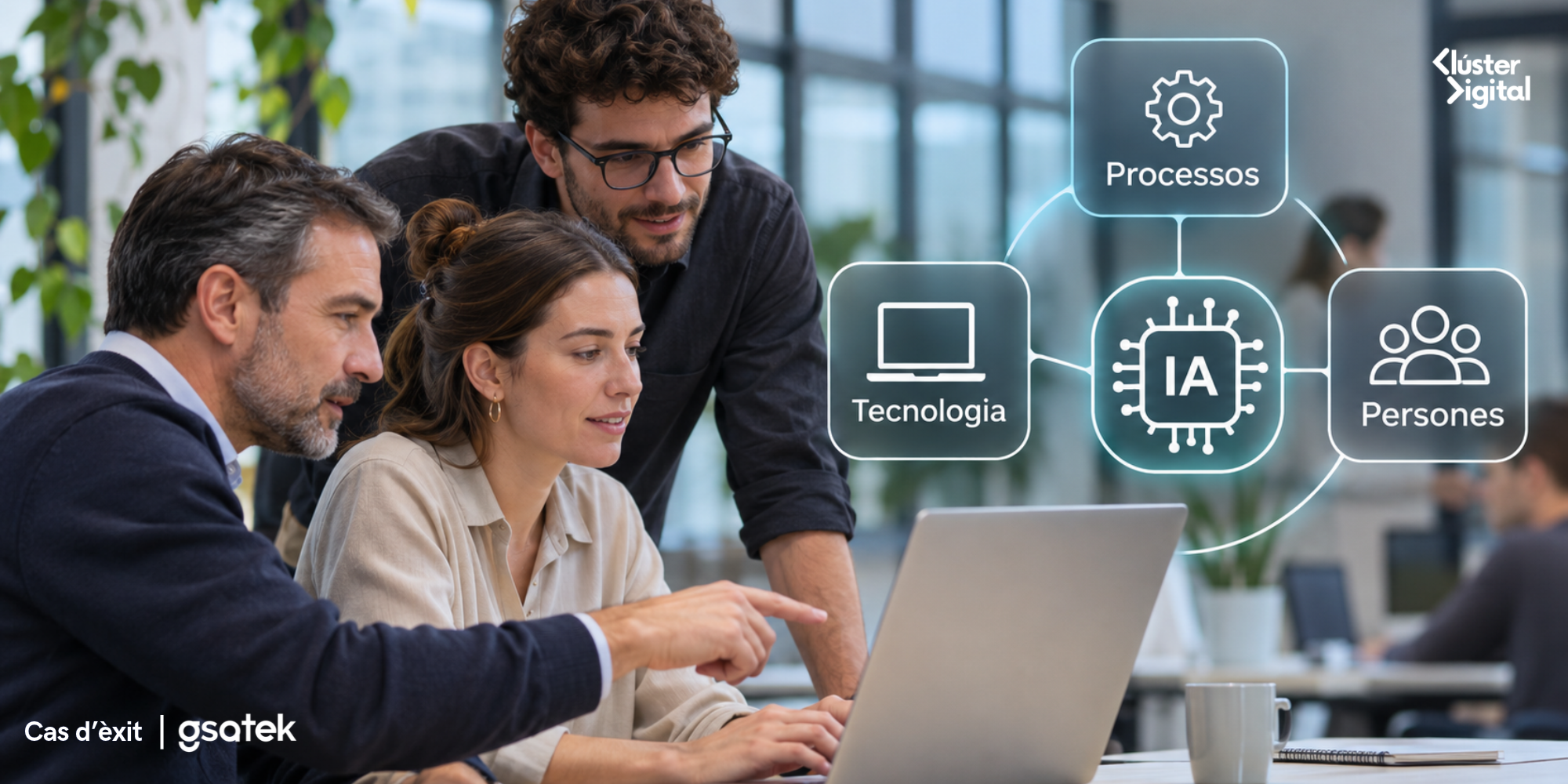
More and more small and medium-sized enterprises are incorporating artificial intelligence tools into their day-to-day operations, often at the initiative of their own teams. However, using these tools does not always mean making the most of their potential. GSATEK is committed to supporting SMEs throughout this process, helping them connect technology, processes and people to turn innovation into tangible results.
How many hours does a company spend manually entering invoices, reviewing documents or searching for information scattered across different spreadsheets? And how much of that time could be redirected towards higher-value tasks if these processes were automated?
Artificial intelligence opens up new possibilities for addressing these needs. In fact, many companies are already taking their first steps: using assistants to prepare documents, tools to analyse information or applications that help streamline specific tasks.
These initiatives can deliver immediate improvements, but they also raise a new challenge. What happens when each department adopts its own tools without a shared strategy? How can these solutions be connected to the systems the company already uses? And how can individual improvements be turned into benefits for the organisation as a whole?
For Noèlia Asensi, CEO of GSATEK, the starting point is understanding what each company actually needs. Before choosing a tool, it is essential to identify which processes can be improved, what challenges teams face and what impact technology can have on business operations.
When AI adoption gets ahead of strategy
Artificial intelligence adoption is accelerating, but it is not always taking place within a structured framework.
According to data published by Spain's National Statistics Institute (INE) on 22 October 2026, 33.6% of companies with 10 or more employees were using artificial intelligence during the first quarter of the year. Among micro-enterprises with an internet connection, the figure stood at 21.4%.
This growth reflects increasing interest in adopting new technological capabilities. However, starting to use AI is not the same as integrating it into the way an organisation operates.
In some SMEs, initial experiments stem from employees' own initiative as they discover useful tools to address specific needs. This is a valuable first step, but without coordination, these initiatives can lead to fragmented information, duplicated processes or applications that do not communicate with one another.
The challenge is not to slow down this experimentation, but to give it direction. Companies do not necessarily need more tools. Often, they need to organise the ones they already use, connect them to their processes and identify where they can deliver the greatest value.
GSATEK: starting by understanding the business
This is the approach adopted by GSATEK, a technology consultancy specialising in business-oriented artificial intelligence, process automation and enterprise management systems. The company supports SMEs across different sectors in their digital transformation, combining consultancy, technology development, systems integration and training.
Its experience in digitalisation projects has helped identify recurring challenges across a wide range of organisations: manual administrative tasks, information scattered across applications, poorly standardised processes and difficulties accessing useful data for decision-making.
The answer does not necessarily lie in implementing a new platform. In some cases, improvement means simplifying a process; in others, connecting existing tools or automating a task that takes up a significant amount of employees' time.
As an Odoo partner, GSATEK also works on integrating enterprise management systems, an important aspect of ensuring that new AI solutions do not operate in isolation.
The goal is to ensure that every technological addition addresses a specific need and fits the organisation's actual circumstances.
From needs to solutions: AI applied to real-world challenges
This approach has also driven the development of five proprietary artificial intelligence products, designed to address specific business needs.
One example is FINIA, a solution that automates processes related to invoice management and financial documentation. In a project for a company in the meat industry, according to data provided by GSATEK, its implementation reduced the time spent on an invoice management process by more than 85%, equivalent to saving over 34 working hours per week.
Another example is LICIA, a tool developed to simplify the analysis of public tender specifications. The solution helps identify requirements, deadlines, award criteria and potential grounds for exclusion, streamlining a task that traditionally requires detailed document review.
These are two different applications, but they share the same underlying principle: identifying a real need and using technology to improve the way people work. This approach extends to other areas, including sales automation, data analysis, information management and integration with ERP and CRM systems.
The challenge of integrating AI into everyday business operations
One of the challenges of artificial intelligence is ensuring that teams adopt it and integrate it into their daily work. Implementing a technological solution does not end when the tool starts working: people need to understand how to use it and the value it can bring to business processes.
That is why GSATEK, a member company of Cluster Digital, considers ongoing support an essential part of the transformation process. Through initial assessments, training, implementation and ongoing support, the company helps businesses develop new capabilities with confidence and autonomy.
For SMEs that have already started experimenting with these technologies, the challenge is to move from individual initiatives towards improvements that involve the entire organisation.
This means connecting tools, standardising processes, ensuring access to reliable information and setting objectives to measure results. In this context, GSATEK provides the expertise and implementation capabilities needed to support companies from identifying opportunities through to implementing and evolving their solutions.
AI does not transform businesses on its own. Its value emerges when it is applied with purpose, integrated into processes and put at the service of people.


